On this page
Why I Rebuilt My Portfolio From Scratch
I'm still a student, and when I thought about making a portfolio, I looked at so many others. They all felt static, the same structure, the same feeling. Like something anyone, even an AI, could generate.
I didn't want that.
I wanted something that felt mine.
I also wanted the name to feel personal. My name is Yassine Boulhaoua, and after playing with parts of my name and surname, I ended up with Boussen. That became the identity I wanted to use, and eventually the domain became boussen.me.
But getting the name was the easy part.
The portfolio itself took me three tries before I started building something I actually felt represented me.
My First Portfolio Looked Like Every Other Portfolio
My first portfolio was very simple.
I searched Google, looked at other developer portfolios, saw how people structured them, and built something similar.
There was a menu, some sections, images, information about me, projects, and the normal things you expect from a portfolio.
Technically, it worked.
But the design was not good. I used too much blue, the structure was basic, and when I looked at it later, I could clearly see that I was still learning.
At that point, that was normal. It was my first try, and I learned from it.
So I made another one.
The Second One Was Better, but It Still Wasn't Mine
The second portfolio was much better.
I had learned more about colors, spacing, structure, and how different parts of a page should work together. The design looked cleaner and more organized.
I was improving, but then I started looking at the portfolio differently.
I asked myself: if I showed this to someone hiring developers, what would they actually see that was different?
The design was better, but the idea was still the same one I had seen everywhere else.
Hero section. About. Projects. Skills. Contact.
Different colors, maybe different animations, but almost the same structure.
By 2026, I didn't want my portfolio to only show that I could put together HTML, CSS or Tailwind, and some JavaScript animations. I wanted it to show more of how I think and what I can create.
I wanted people to see that I could be creative, not only that I could build a normal website.
So instead of redesigning the same portfolio again, I decided to start from zero.
I Stopped Looking for Another Portfolio Design
This time, I didn't want to begin by searching for another portfolio to copy.
I started asking what I could build with what I already knew. I wanted the portfolio itself to be part of the work I was showing.
That is where the desktop idea started.
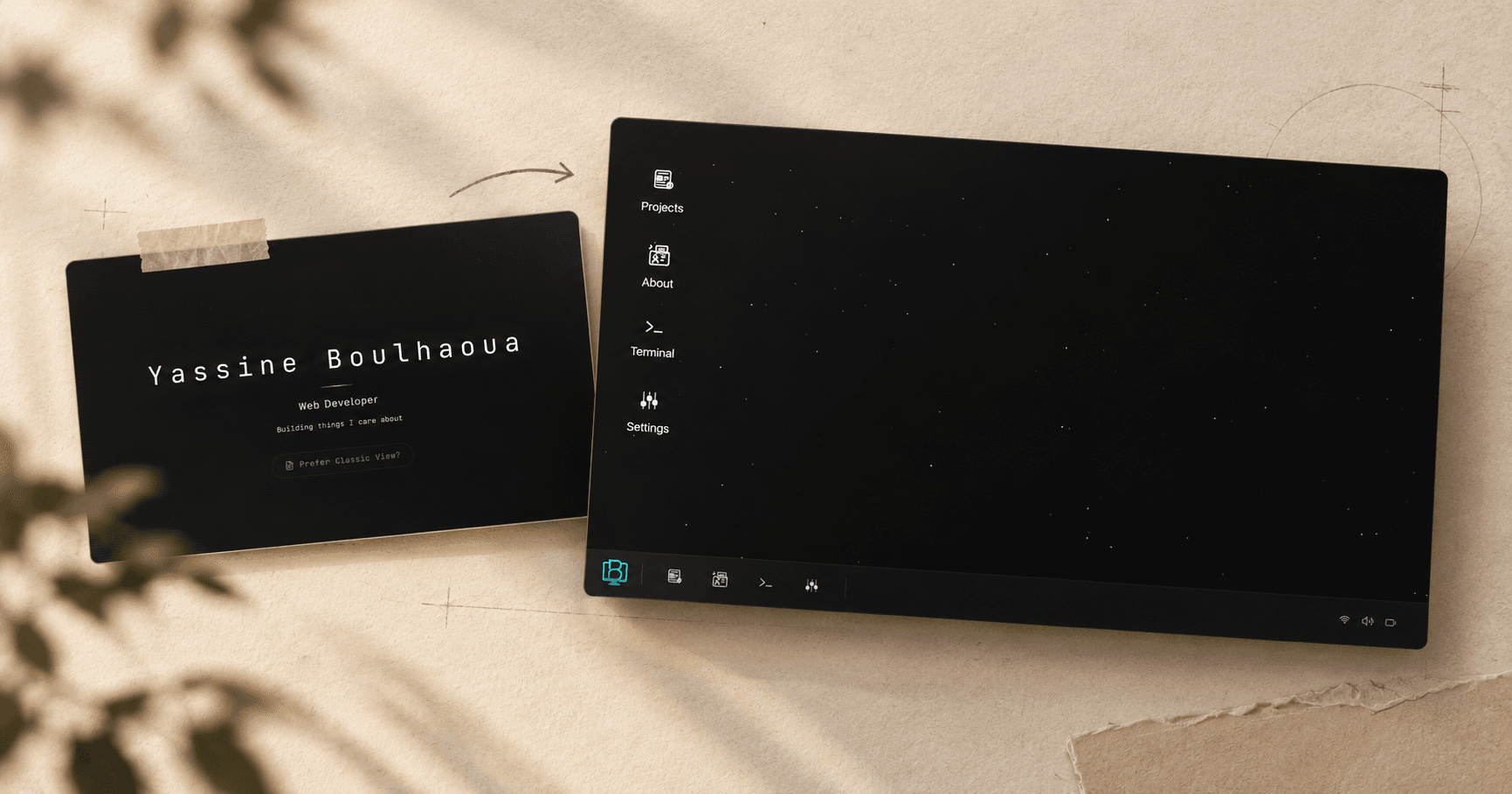
Instead of a normal website with sections one under another, I wanted it to feel more like opening a small operating system.
Projects could be folders. About could have its own place. I could have a terminal, settings, and windows that open and move.
The portfolio could be something you interact with instead of just something you scroll through.
That idea eventually became Boussen OS.
For the first time, I felt like I wasn't only changing colors or moving sections around. I was building my own structure.
Building Boussen OS Was Harder Than Having the Idea
The first version of Boussen OS was not the version I have now.
The background was bad, some parts of the structure were confusing, and the design still needed a lot of work.
At one point, I also experimented with 3D ideas, but I didn't like where that was going.
I didn't want a portfolio that only looked impressive on my machine. I wanted it to work properly on older computers too, and I wanted the mobile experience to be good.
That changed a lot of my decisions.
I kept working on the design little by little. I changed the structure, removed things that didn't feel right, improved the animations, and kept thinking about performance while building it.
It took a lot of iterations before I reached a version where the design and the structure finally felt right together.
And almost everything in that experience came from ideas I wanted to try myself: the desktop concept, the animations, the logo, the structure, and how the different parts interact.
AI helped me while building, but I didn't want AI to decide what the portfolio should be.
I wanted the ideas to come from me.
There was also something else I had to think about.
After spending so much time making the portfolio different, I realized that visitors still needed to understand what they were opening.
Someone shouldn't have to explore the whole desktop just to know whose portfolio it is.
So I added a short loading introduction before entering Boussen OS. It gives the visitor the basic context: Boussen, developer, portfolio.
Then they enter the experience.
I liked that small addition because I wanted the portfolio to feel different without making its purpose confusing.
What I Learned From Rebuilding It
The biggest thing I learned was not really about portfolios.
It was about copying.
Looking at other people's work is useful. I learned a lot from doing that, especially with my first and second portfolios.
But I realized that if I kept starting from other people's structures, I was always going to end up with another version of something that already existed.
The third time, I stopped asking:
What does a developer portfolio normally look like?
And started asking:
What can I build that actually shows the way I think?
My first portfolio showed that I could make a website. My second one showed that I was getting better at design.
With Boussen OS, I wanted to show something more about myself.
I wanted people to see that I can be creative, and that I can take an idea of my own and build something around it.
That's why I rebuilt my portfolio from scratch.